Cinuyep:243 ida.jpg
Tan cietokonukarpe サイズ: 800 × 579 ピクセル. その他の解像度: 320 × 232 ピクセル | 640 × 463 ピクセル | 905 × 655 ピクセル.
元の cinuyep (905 × 655 ピクセル、 cinuyep サイズ: 20 KB、MIME タイプ: image/jpeg)
Summary
| Description |
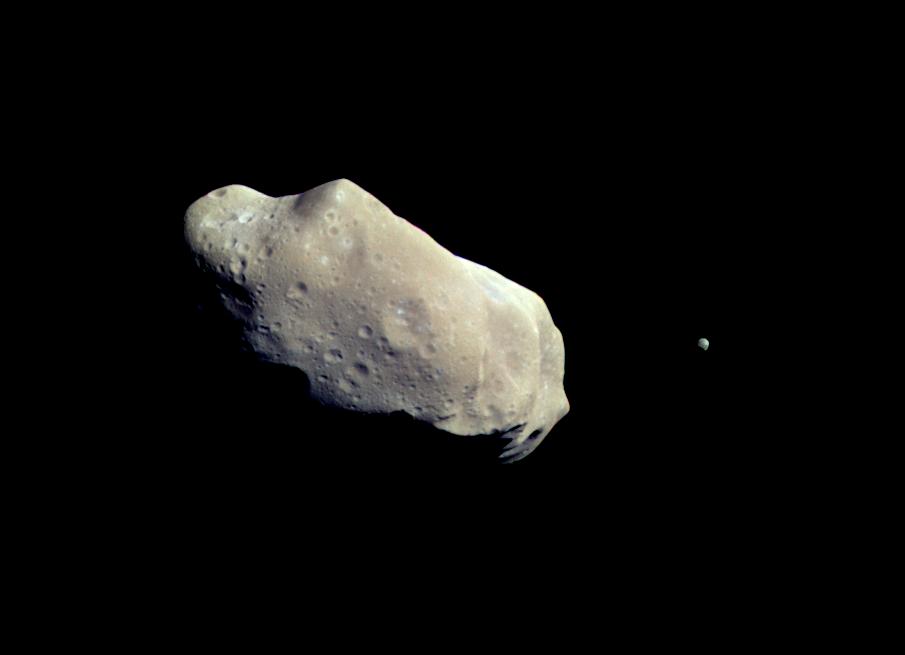
English: This color picture is made from images taken by the imaging system on the Galileo spacecraft about 14 minutes before its closest approach to asteroid 243 Ida on August 28, 1993, at a distance of about 10,500 kilometers (6,500 miles). The images used are from the sequence in which Ida's moon was originally discovered; the moon is visible to the right of the asteroid. This picture is made from images through the 4100-ångström (violet), 7560 Å (infrared) and 9680 Å (infrared) filters. The color is 'enhanced' in the sense that the CCD camera is sensitive to near-infrared wavelengths of light beyond human vision; a 'natural' color picture of this asteroid would appear mostly gray. Shadings in the image indicate changes in illumination angle on the many steep slopes of this irregular body as well as subtle color variations due to differences in the physical state and composition of the soil (regolith). There are brighter areas, appearing bluish in the picture, around craters on the upper left end of Ida, around the small bright crater near the center of the asteroid, and near the upper right-hand edge (the limb). This is a combination of more reflected blue light and greater absorption of near infrared light, suggesting a difference in the abundance or composition of iron-bearing minerals in these areas. Ida's moon also has a deeper near-infrared absorption and a different color in the violet than any area on this side of Ida. The moon is not identical in spectral properties to any area of Ida in view here, though its overall similarity in reflectance and general spectral type suggests that it is made of the same rock types basically. These data, combined with study of further imaging data and more detailed spectra from the Near Infrared Mapping Spectrometer, may allow scientists to determine whether the larger parent body of which Ida, its moon, and some other asteroids are fragments was a heated, differentiated object or made of relatively unaltered primitive chondritic material.
Čeština: Planetka (243) Ida se svým měsíčkem Dactylem
Deutsch: Asteroid Ida mit Mond Dactyl
Magyar: A Galileo űrszonda fényképe a 243 Idáról. Jobbra halványan látszik a Dactyl.
日本語: ガリレオ探査機が撮影したイダと衛星ダクティル(右の点)
中文(简体):艾达和它的卫星:伽利略木星探测飞船,在它飞向木星的旅途之中碰上了两颗小行星,第二颗就叫做艾达。伽利略飞船发现它有一颗卫星,就是图片右方的小点。这颗卫星被命名为Dactyl,直径大概有1.6千米;而土豆状的艾达则有58千米长,22.5千米宽。这是人类首次发现小行星有卫星。 |
|||||
| Date | ||||||
| Source |
NASA planetary photojournal |
|||||
| Author | NASA/JPL | |||||
| Permission (Reusing this file) |
|
|||||
| Other versions | Derivative works of this file: 243 ida crop.jpg |


| Annotations | This image is annotated: View the annotations at Commons |
Cinuyep huskoanpe
Husko cinuyep werson a=nukar kusu nea werson pácupto kik wa un=kore yan.
| 日付と時刻 | サムネイル | 寸法 | Iyeywankekur | コメント | |
|---|---|---|---|---|---|
| 現在のwerson | 2022 ppm 9 2022-09-10T23:59:40+00:00up 10 302022 (Toy.) 23:59 | | 905 × 655 (20 KB) | wikimediacommons>BevinKacon | Reverted to version as of 10:44, 30 January 2006 (UTC) the NASA page clearly states original resolution as Product Size: 905 x 655 pixels (w x h) |
Cinuyepの使用状況
以下のsosが tan cinuyep を使用しています:
